
Give each shopper a clear next step: browse the products you actually have, check whether a costume or party kit fits their needs, then choose a reliable way to buy or visit. A Halloween retailer can make that path easier with a focused seasonal page, current availability information, and ads that lead to the matching products. More clicks alone do not fix a confusing catalog or an offer the store cannot fulfill.
That matters whether you run a costume shop, a neighborhood party store, or a year-round retailer giving Halloween its own corner. The National Retail Federation’s 2026 survey estimated $13.5 billion in planned Halloween spending. That is consumer intent, not a sales forecast for your store. Let your inventory and customer behavior guide the offer. (NRF’s 2026 Halloween survey)
What should the seasonal page answer first?
Answer the questions a shopper needs resolved before they commit: What do you sell, what is available, what sizes or components are included, where can I get it, and by when? Put those answers on one mobile-friendly page rather than sending visitors through a general homepage and a maze of categories.
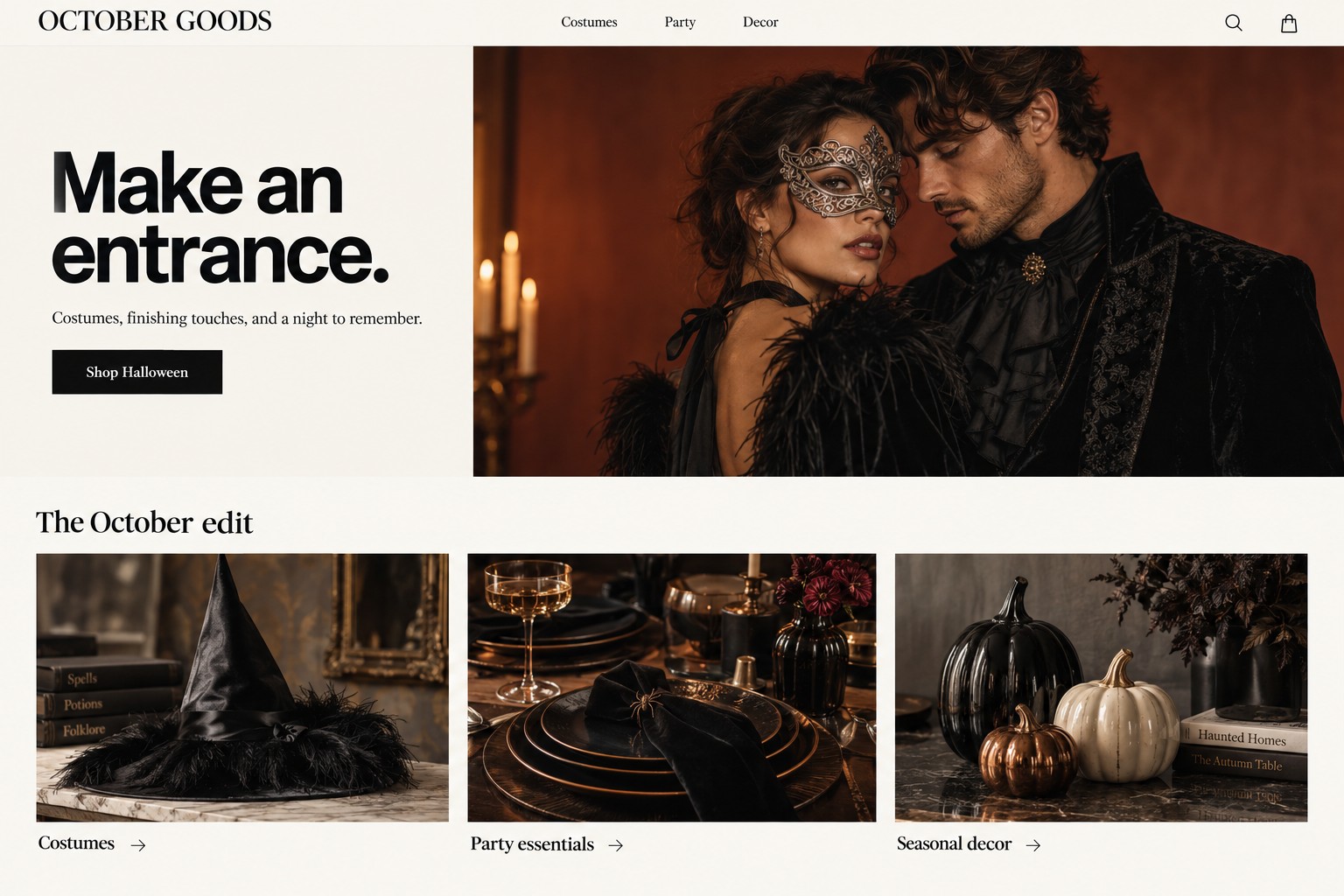
Here is a fictional page brief for a shop called October Goods. Its real inventory, pickup terms, and policies would need to replace the illustrative copy below.
Hero headline: “Build your Halloween look, from costume to last detail.”
Supporting copy: “Shop costumes, accessories, and party supplies currently available at our store. Check product details and choose local pickup or shipping at checkout.”
Primary button: “Shop Halloween”
Secondary link: “Get directions and store hours”
Below the hero, organize the page around decisions: shop costumes by age or type; add accessories and makeup; build a party table; see pickup, shipping, and cutoff details; then get answers to sizing, returns, and store-location questions. Keep claims such as “in stock” tied to a process that staff can update. If stock changes quickly, say how a shopper can confirm an item before driving over. Do not promise same-day pickup unless the store can consistently support it.
Make the product page finish the sale. Show clear photos, sizes, what comes in the package, price, available quantity or a truthful availability note, and the next step. A shopper choosing a child’s costume should not have to guess whether the pictured wig or accessory is included. A party host should be able to tell whether plates, napkins, and decorations belong to the same set.
How could a store make an offer without discounting everything?
Build a useful bundle around a real customer task, then check its contribution before promoting it. A “costume plus finishing touches” set or a coordinated party table may reduce shopping friction while preserving the value of individual items. The bundle should use products that are actually available together, and its price should reflect product cost, payment fees, packaging, and any fulfillment expense.
Fictional offer and capacity example: October Goods has 24 complete “moonlit party table” kits it can assemble from its current stock. Each kit sells for $48 and costs $27 in merchandise and packaging to prepare. That leaves $21 before payment fees, advertising, labor, rent, and other fixed costs. The shop decides to promote a $5 add-on accessory instead of cutting the kit price. It reserves four kits for walk-in shoppers and lists 20 online. This arithmetic is illustrative, not a benchmark or result. The owner should substitute actual costs, stock, and staffing limits before setting an offer.
Show the offer where the decision happens: on the category page, relevant product pages, social posts, and any ad that specifically mentions it. If the online kit sells out, the page should stop inviting payment for it and offer a truthful alternative, such as the remaining individual items or an in-store availability check.
Where do Google Ads and social fit?
Use Google Ads when the store has a ready product page, a defined service area or shipping offer, and a way to check availability. A search ad for “adult vampire costume” should land on a relevant, working category or product page, not a generic page that makes the shopper start over. Set geography, budgets, and promoted products around what the business can serve. Monitor inquiries and completed orders alongside spend; an ad platform’s clicks do not equal profitable sales.
Social media can show the assortment in context: a short video assembling a costume, a side-by-side party table, new stock, or a staff-picked display. Each post needs an accurate destination and current details. Use social promotion to help people discover and evaluate what is available, not to imply that a trend guarantees demand.
AMÁRQUEZ can help a retailer plan or improve a seasonal web page, connect an ad to a suitable destination, and shape social content around the store’s real assortment. The right scope depends on the site, timing, inventory process, and budget. No campaign can guarantee a ranking, a certain number of customers, or a profitable return.
Questions retailers ask
Should I advertise products that are almost sold out?
Only if the page makes availability clear and the store can pause or change promotion quickly. Directing more visitors to a product that cannot be fulfilled wastes the shopper’s time and the business’s budget.
Do I need a separate Halloween website?
Usually, a clear seasonal page within your existing site is easier to maintain and connect to the rest of the catalog. A separate site may create extra work for inventory, trust, and checkout without solving the underlying navigation problem.
Is it too late to start a page for Halloween 2026?
A focused update to an existing page may still help people who are looking now, if the store can verify information and fulfill orders. A new page or campaign has no guaranteed time to gain visibility. Prioritize accurate availability, a working purchase path, and channels that can reach your existing audience.
If your Halloween page gets visits but shoppers still call to ask what is available, where to go, or how to order, talk with AMÁRQUEZ. Share your website, campaign date, and the main obstacle. We can discuss whether page design, Google Ads, social media, or a smaller change is the sensible next step.