
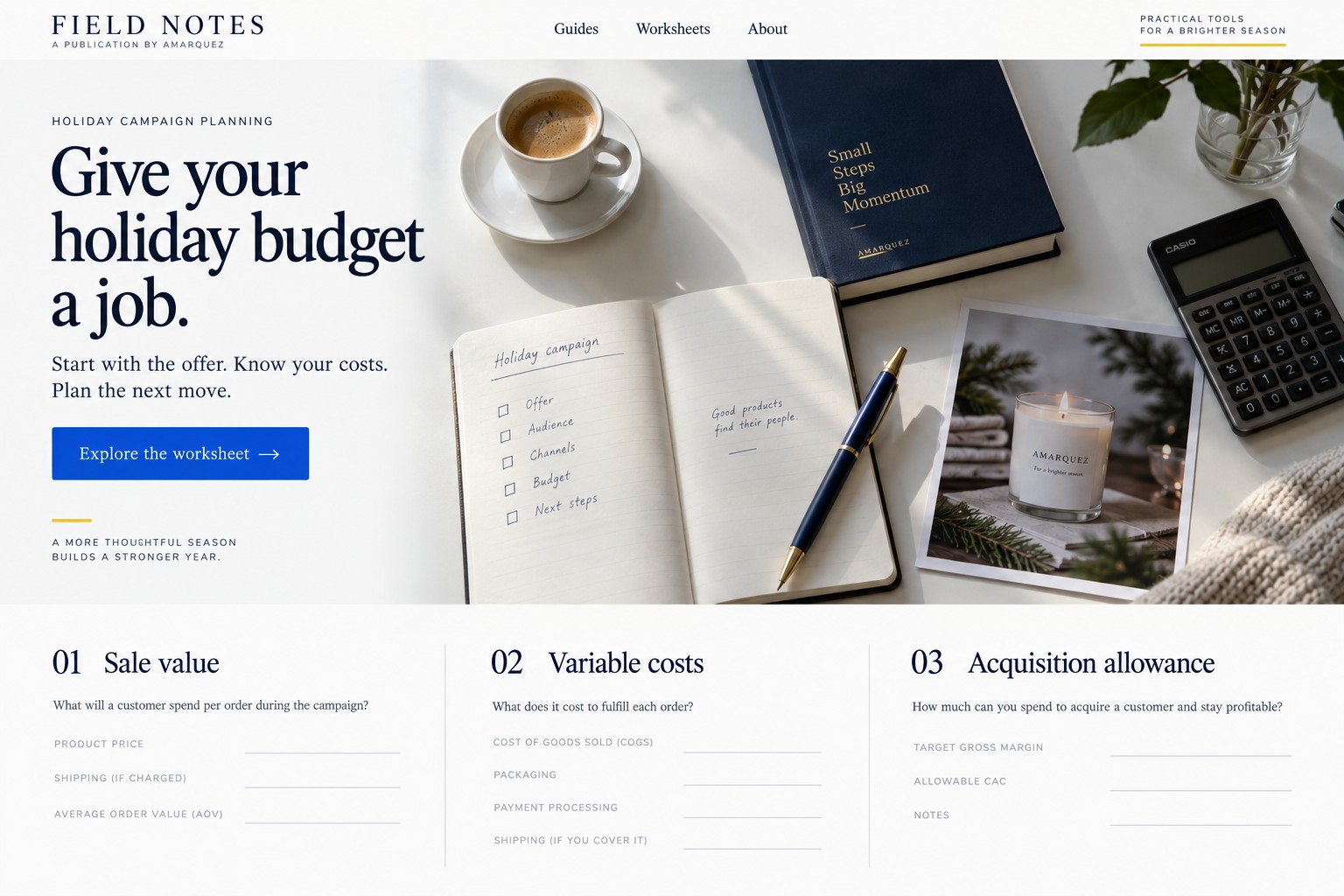
A holiday advertising budget should start with the amount a new customer can contribute after variable costs, then work backward through your expected cost per click and the share of clicks that become paid sales. The example below is hypothetical, not an industry benchmark; replace every assumption with your own numbers before spending.
What should a holiday ad budget be based on?
Base it on the economics of the specific offer and the capacity you can fulfill. A budget copied from another business cannot tell you what you can afford to pay for a customer. Start with a conservative estimate of sale value, subtract the costs that rise when you make and deliver that sale, and decide how much of the remaining contribution can go to acquiring a first-time customer.
For example, if a seasonal package sells for $220 and its variable delivery costs are $99, its contribution before advertising is $121. That is the theoretical ceiling for acquisition cost if you are willing to spend all first-sale contribution on acquiring the customer. A business that needs the first purchase to also cover fixed overhead or leave profit should set a lower ceiling. Include payment fees, materials, commissions, shipping, discounts, and any other cost that changes with the sale. Do not count future repeat purchases unless you can support that estimate with your own customer records.
How do I work from an ad click to a paid sale?
Write the path as a small funnel: ad click, relevant landing-page visit, offer or booking action, checkout start, and completed paid order. The final rate that matters for this simple calculation is completed paid sales divided by clicks. You can also measure the intermediate steps to find where shoppers leave, but do not label an enquiry, checkout start, or unconfirmed booking as a sale.
Here is one fully hypothetical scenario for a local seasonal service. Assume a $2,000 media budget, a $5 average cost per click, a $220 sale, and $99 in variable fulfillment cost per sale. Assume each paid order is the first purchase by a different new customer. The acquisition calculation below includes media spend only; creative, setup and management costs must also be budgeted. The figures are planning inputs only. They are not a claim about normal ad costs or conversion rates.
| Step | Hypothetical calculation | Result |
|---|---|---|
| Media budget | Set amount | $2,000 |
| Clicks purchased | $2,000 ÷ $5 per click | 400 clicks |
| Paid-sale conversion rate | Assume 4% of clicks buy | 400 × 0.04 = 16 sales |
| Customer acquisition cost | $2,000 ÷ 16 paid sales | $125 per sale |
| Contribution before ads | 16 × ($220 − $99 variable cost) | $1,936 |
| Contribution after media | $1,936 − $2,000 | −$64 |
| Alternate conversion case | Assume 5%: 400 × 0.05 = 20 sales; $2,000 ÷ 20 = $100 CAC | 20 × $121 − $2,000 = $420 after media |
In the 4% case, the $125 customer acquisition cost is higher than the $121 first-sale contribution, so the campaign loses $4 per sale before fixed costs. In the 5% illustration, acquisition cost is lower and the modeled campaign has $420 left after media, before overhead and taxes. The difference comes from an assumption in the scenario, not a promised outcome. Actual click prices, purchase rates, order mix, cancellations, and fulfillment costs may differ.
How can I choose an affordable customer acquisition cost?
First decide how much contribution you want to retain from each first purchase. If a $220 offer contributes $121 before ads and you want to keep $31 for overhead and profit, then the remaining $90 is the maximum affordable acquisition cost under those assumptions. At $5 per click, a $90 CAC would require at least 5.56% of clicks to become paid sales: $5 ÷ $90 = 0.0556. That calculation gives you a planning threshold. It does not predict that your page will reach it.
Set a stop point and review actual paid sales, not just platform-reported activity. Check that your order system and ad conversion setup agree about what counts as a purchase. Google Ads attribution assigns credit across eligible ad interactions according to the selected attribution model, and conversion windows determine how long after an interaction a conversion can be recorded. Those settings affect reporting; they do not change whether money actually arrived in your checkout. Compare the ad report with paid orders and note the date range and measurement settings when reviewing results.
What does Google Ads' daily budget mean?
Google describes a campaign budget as an average daily budget. For most campaigns, Google may spend up to twice the average daily budget on a particular day while applying a monthly spending limit of average daily budget multiplied by 30.4. If you are setting a short seasonal campaign, account for the campaign dates and the amount you can tolerate on a busier day. Review current account and campaign settings before launch because budget type and campaign behavior matter. The platform's spending limit does not make an unprofitable campaign profitable.
What should the holiday ad and landing page say?
Match the ad to a specific gift, service, or appointment and send the click to a page where the same offer is easy to understand and buy. Google defines the landing page as the page reached after an ad click and says the page and display URL must share a domain. Its landing-page guidance also emphasizes useful, relevant information and straightforward navigation. Keep the price, availability, location, purchase steps, and any material offer conditions visible before asking for payment.
Hypothetical search ad: “A Quiet Hour, Ready to Gift | Stillwater Studio | Choose a massage or facial gift card online. View available options and appointment details.” The ad should lead directly to the matching gift-card page, not a generic homepage that forces the visitor to search again. Use this only if the studio actually offers those services and the page reflects the live terms and inventory.
How can a small business adjust the campaign safely?
Test one meaningful change at a time: a more specific offer, clearer service details, a faster purchase path, or creative that answers a real seasonal question. Keep audience, geography, offer, and measurement definitions in view when comparing periods. If a service business is already near appointment capacity, cap promotion or reserve only the slots the team can deliver. For gift cards, plan for redemption demand after the purchase rush as well as the sales season.
AMÁRQUEZ can shape a campaign page through web design, connect paid search planning through Google Ads support, and create social media that explains the offer and points to the same page. Campaign results depend on the offer, demand, capacity, and measurement, so no sales volume is promised.
For adjacent seasonal planning, read Black Friday retail advertising and holiday party venue marketing. Use the same discipline in either case: define what a paid conversion is, calculate the contribution available to acquire it, and make the next step clear after the click.