
A salon or spa can market holiday gift cards by making the purchase simple for the giver, the first visit easy for the recipient, and redemption realistic for the team’s appointment capacity. Treat the sale and the later service visit as two separate moments, with a clear offer and plain-language terms for each.
Why can a gift card work for a local experience?
A gift card lets one person choose the amount or experience while the recipient chooses when to use it. That can fit a haircut, facial, massage, manicure, class, tasting, or other local experience when the offer is specific enough to feel thoughtful and flexible enough to schedule. In NRF’s December 2025 holiday research, 43% of shoppers planned to buy at least one gift card. That is historical national survey context, not a forecast for a particular studio or neighborhood. (NRF’s 2025 gift-card research)
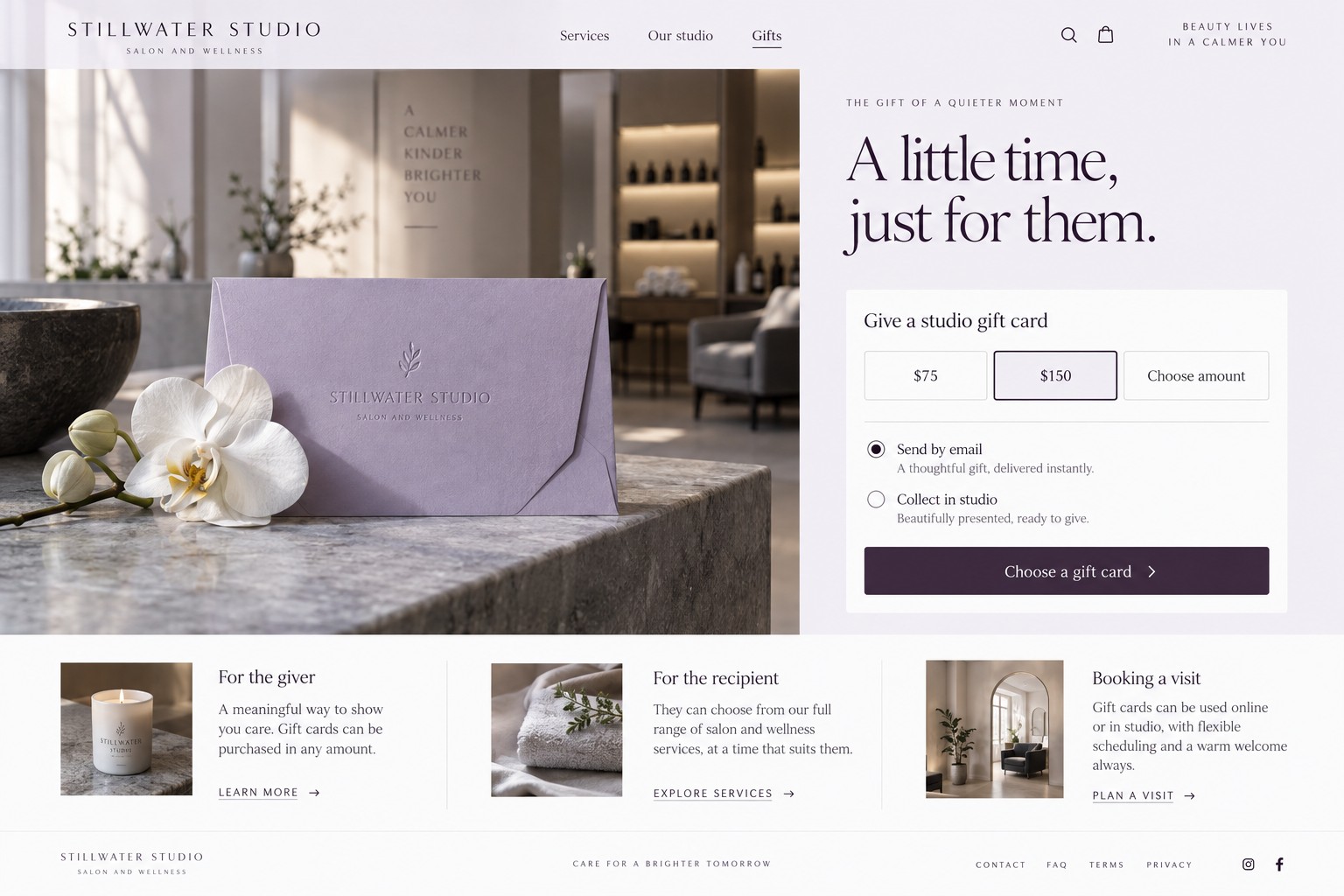
Consider a fictional campaign called Stillwater Studio. Its holiday page could present a $75 studio gift card, a $150 card, and a “Quiet Hour” experience that combines a service with a short consultation. These are illustrative concepts, not claims about an actual business or recommended prices. The business should choose amounts and packages after checking service costs, staff time, and appointment availability.
How should the message differ for the purchaser and recipient?
The purchaser needs confidence that the gift is easy to buy and present. Show the available amounts or experiences, accepted payment methods, delivery format, and whether the card can be sent immediately or prepared for a chosen date. If physical pickup is available, say where and when. A concise message might be: “Give them a quieter afternoon. Choose a Stillwater Studio gift card online and send it by email, or pick up a printed card at the studio.” Only mention options the business actually supports.
The recipient needs confidence that the gift will be easy to use. Explain which services accept it, how to book, whether the amount can be used across more than one visit, and how to ask about the remaining balance. If the studio has peak periods, explain how the recipient can find available appointments and whether advance booking is recommended. A purchaser-focused campaign can generate sales while leaving the recipient confused; a recipient-focused booking page closes that gap.
What should the gift-card page include?
Put the essentials together on one page: a short description of the experience, the available card formats and amounts, purchase and delivery steps, redemption instructions, contact details, and the business’s current policies. Use real photos of the space or service if available, with descriptive alt text. Keep the purchase button easy to find on a phone, and make the next step clear after checkout.
Put the business’s approved purchase and redemption terms beside the offer. Explain applicable restrictions, promotional bonus conditions, and where buyers can ask questions before paying. Keep these details consistent across the page, checkout and confirmation message.
How can a campaign avoid creating a redemption bottleneck?
Estimate how many extra visits the campaign could bring and compare that demand with real appointment capacity. A salon can look at staffed hours, service lengths, room availability, and its usual mix of appointments. A class or local experience can use seat counts and session dates. Set promotion volume and any featured package around what the team can deliver while serving existing customers.
For example, a fictional studio might decide that only a limited number of “Quiet Hour” appointments can be accommodated each week in January and February. If that package is promoted, the page should say how recipients find an available slot and what happens if their preferred date is full. Do not imply guaranteed dates unless they are actually reserved. A monetary gift card may be easier to schedule across several services, but the team should still forecast when recipients are likely to book and how redemptions will be recorded.
Track gift cards through both stages: purchase and redemption. At purchase, record the channel, amount or package, and completed payment. At redemption, record the card identifier, date, service, and remaining balance using the business’s approved system. This helps answer practical questions: Which message led to sales? Which cards have been used? Are redemptions clustering around a few weeks or services? Keep the definitions clear. A gift card sold is a paid order; a recipient booking is a later fulfillment event. They are not two separate new-customer sales.
What should the holiday creative say?
Lead with the gift and make the action unmistakable. A social post for Stillwater Studio could read: “For the person who makes time for everyone else: give them a little time of their own. Choose a Stillwater Studio gift card online, then let them book the visit that fits their week. See service options and redemption details.” Pair the copy with a real, calm image of the studio or treatment room and a link to the matching gift-card page. Do not use urgency, limited quantities, or service details unless they are true and current.
Use a small set of connected touchpoints rather than a different offer in every channel: a website banner, a gift-card page, email to opted-in customers, and social posts that answer common questions. A reminder can explain digital delivery for late shoppers; another can show how a recipient books. If the business uses paid search, send the ad to the purchase page and make sure the ad’s wording matches what is available there.
How can AMÁRQUEZ help promote a gift-card offer?
AMÁRQUEZ can build a holiday gift-card page through web design, plan paid search through Google Ads, and develop social media creative that explains the offer. Each should point to current purchase and redemption details. Results depend on the offer, local demand, capacity, and measurement; no sales volume is guaranteed.
For related seasonal planning, see holiday party venue marketing and Black Friday retail advertising. For any campaign, the useful question is simple: can the person who buys understand the offer, can the person who receives it redeem it, and can the business provide it when the time comes?