
Developing with AI November 9, 2026
Calling your AI an expert
doesn’t make it one.
AI can help you build. Your judgment decides whether the work is accurate, useful and ready for customers.
01 / The assumption
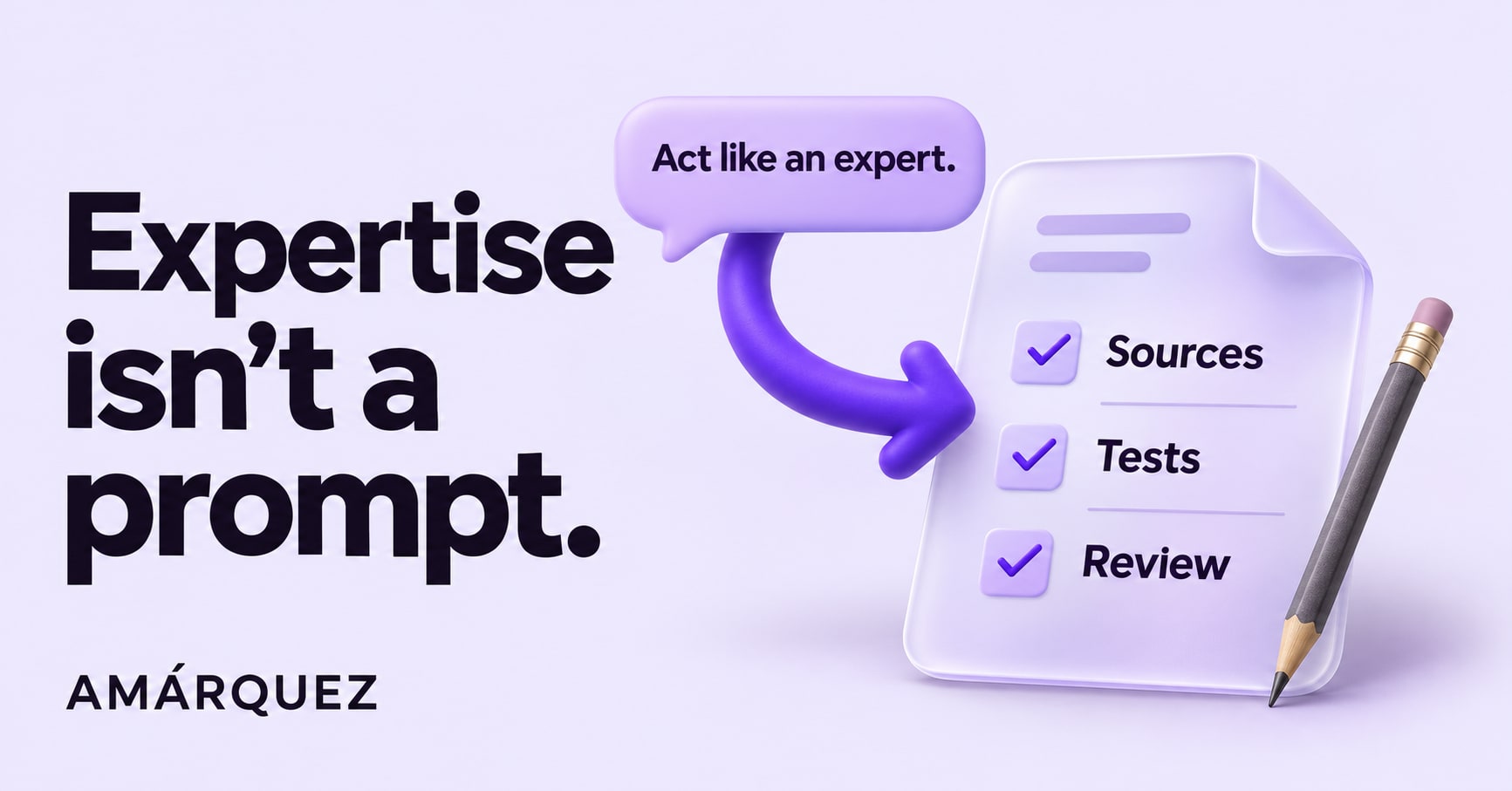
“Act like an expert” is a role. Where is the evidence?
Telling AI to act like an expert does not establish that its answer is correct. A useful brief needs the facts, constraints and checks that the work depends on.
“You are a world-class developer and SEO expert. Build my website. Make no mistakes.”
That sounds like a demanding brief. It says almost nothing about your customers, your services, the code, the evidence behind the content or what a successful website needs to do.
A role can help focus an AI’s behavior and tone. Anthropic recommends it for that purpose. The mistake is treating the role as proof of expertise. An answer can sound authoritative before anyone has checked whether it is true.
If you cannot judge the work, the confidence of the answer can become your quality standard. That is a weak foundation for a business.
02 / What the research found
Confidence and competence need different checks.
A 2024 study published in Findings of EMNLP tested 162 personas across four model families and 2,410 factual questions. Adding personas did not consistently improve factual performance. Giving the model a professional identity was not a reliable route to more accurate answers.
OpenAI’s research on hallucinations identifies a deeper problem: common training and evaluation incentives reward guessing over acknowledging uncertainty. A fluent, specific answer can still be wrong. “Make no mistakes” does not supply the missing evidence.
There is a learning problem too. In Anthropic’s randomized study of developers learning a new Python library, the AI-assisted group averaged 50% on a follow-up quiz, compared with 67% for the group coding without AI. Completion time was not significantly faster. Participants who used AI to ask questions and build understanding showed stronger mastery than those who handed over the thinking.
Finishing a task and understanding it are different achievements. You need the second to review the first.
03 / Where businesses feel it
A finished-looking website can still be unfinished work.
A polished page can hide basic failures: service claims nobody checked, headings that say very little, inaccessible controls, a contact form that never delivers, or pages a search engine cannot reach.
Calling the model an expert does not check any of those things. Someone has to understand the requirements and verify the result.
In our six-month review of 75 websites, the generic AI-built sites among new clients had the highest bounce rates. Repeated layouts and weak brand identity made different businesses look interchangeable. Visitors needed clear information about the business in front of them.
Our plumbing company case study shows what specific work looks like: rewriting service content, separating topics across the right pages, improving internal links and addressing crawl and speed issues. Each change had a job to do.
That is the standard to bring to AI development. Ask what the page needs to achieve, what is missing and how you will know the result works.
04 / Google’s rules
Does Google penalize AI content?
Using AI is not, by itself, against Google’s guidelines. Google’s guidance on AI-generated content focuses on helpful, original content and the purpose behind its creation.
Its current generative AI guidance calls for manual fact-checking and review before publication. Its scaled content abuse policy targets large amounts of content created primarily to manipulate rankings rather than help users, regardless of how that content was produced.
For a service business, this makes the brief practical. Explain the actual service, the real service area, the questions customers ask and the evidence that supports your claims. Check every qualification, price and promise before it reaches the page.
A hundred vague pages do not become useful because a prompt called their author an SEO expert.
05 / A better way to build
Give AI a brief you can verify.
Tell it what to inspect, which evidence to use, what it must preserve and what needs testing. For a service-page update, that could look like this:
Review this service page using the supplied business information and current Google Search documentation. Identify unsupported claims and missing customer answers. Ask for facts you cannot verify. Keep the brand and existing working features. Propose the changes, explain the evidence, then test mobile navigation, accessibility, links and form delivery. Report what passed and what remains unverified.
Then check the work. Open the sources. Read the changes. Try the website on a phone. Confirm that an enquiry reaches its destination. Compare performance with the previous version.
A stronger prompt gives the work direction. The review tells you whether it meets the brief.
06 / The skill still matters
Learn the work you are asking AI to do.
AI can make a skilled person faster at parts of their work. It can also help a beginner learn. Ask why a change is needed, inspect the answer and learn enough to challenge it.
The way websites and software get built is changing. Customers still need accurate information, usable pages and working services. Businesses still need security, reliable delivery and a clear reason for someone to choose them.
If you already understand those standards, you can direct AI toward them. If you are starting now, learning them is part of the job.
Use AI to build faster. Keep enough understanding to decide what deserves to go live.
Explore our web design work, SEO services and article on ChatGPT business visibility.