
A useful National Coffee Day marketing campaign combines an affordable offer for the business, a clear mobile ordering page and a reason for customers to return. Start with the orders your team can serve, then choose advertising and follow-up that fit that capacity.
When should a coffee-day campaign run?
National Coffee Day in the United States is September 29. International Coffee Day is October 1. They are separate celebrations, and a café can participate in either or both. Confirm the dates in your advertising and give every offer its own start and end time. See the National Coffee Association’s coverage and the International Coffee Organization’s event information.
If September 29 has already arrived, use a simple offer your staff can fulfill. October 1 provides another relevant occasion, but it does not make an expired September promotion valid. A business can run a separate weeklong promotion with clear terms; there is no need to describe the whole week as an official holiday.
Do not make a short campaign depend on a new blog ranking immediately. Google says crawling can take a few days to a few weeks. Your existing audience, in-store signs and appropriately targeted advertising can support the immediate launch while the page remains useful for later planning.
What should an independent coffee shop offer?
Choose an offer with a clear customer benefit and enough contribution to cover the promotion. A drink-and-pastry bundle can be easier to understand and cost than an unrestricted giveaway. Specify the drink size, eligible pastry, substitutions, redemption limit and stock conditions before the first customer arrives.
For a Fresno café, a hypothetical morning pickup bundle could serve nearby customers who already pass the shop on their way to work. Set the collection window around your actual queue and staffing. A roaster selling online needs a different offer: a tasting pack with visible bag weights, grind options, shipping charges and dispatch timing. Introduce a subscription only when the recurring price and renewal terms are clear.
Worked example / Assumptions, not client results
An $8 bundle is not $8 of profit.
- Bundle revenue: $8.00, excluding sales tax.
- Illustrative variable costs: $3.20 for ingredients, packaging, transaction fees and incremental labor.
- Contribution before advertising: $8.00 − $3.20 = $4.80.
- If advertising costs $1.50 per fulfilled bundle, contribution after advertising is $3.30.
That remainder still needs to contribute to rent and other fixed costs. The $1.50 is a planning assumption, not an expected advertising result. Use your own costs, and do not justify a loss with repeat purchases you have not measured.
Before approving the offer, calculate how many orders the counter can handle. Pause promotion or reduce the pickup slots when that limit is reached. A longer queue and a disappointed regular are also campaign outcomes.
What belongs on the coffee promotion landing page?
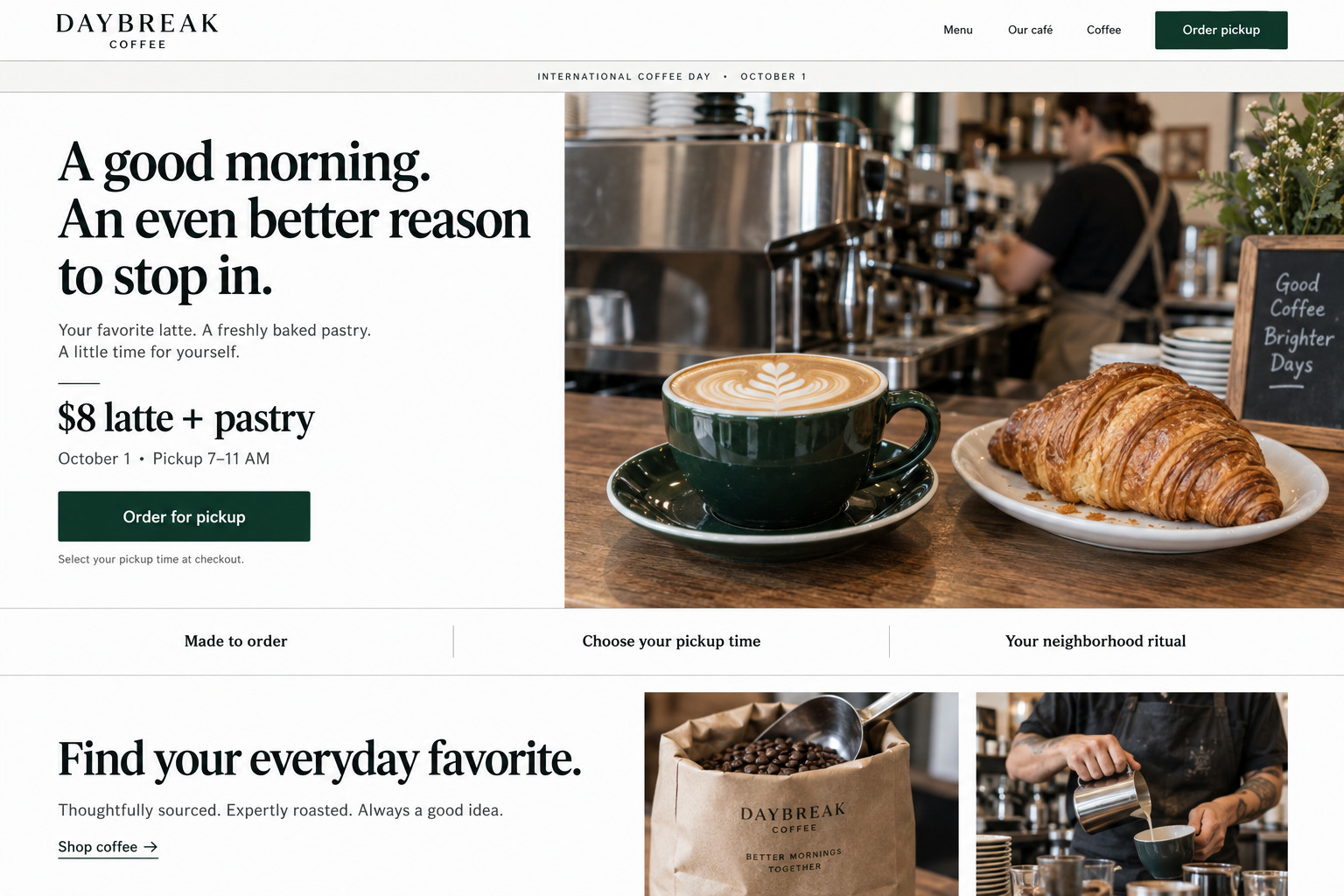
Show what customers receive, what they pay, where they collect it and how they order before asking them to navigate a full menu. The concept above brings those decisions into one screen, with real-looking product photography and a prominent pickup button.
- Offer: a specific drink and pastry, the price and any important exclusions.
- Availability: the correct date, local pickup window, location and genuine stock limits.
- Ordering: a direct route to the matching item in your working ordering system.
- Confirmation: a receipt with the selected pickup time, address and order details.
Test the whole journey on a phone. An “Order for pickup” button should reach the advertised bundle, not an unrelated homepage. If online ordering is unavailable, say “View the offer and visit us” and display the address and hours. Do not promise a reserved order that the business cannot receive.
For a roaster, replace pickup information with delivery costs, dispatch timing and an accessible checkout. Keep the terms in readable HTML, even when they also appear in a promotional image. Descriptive image alt text helps explain the picture; it is not a substitute for the actual offer text.
How should a café advertise the offer locally?
Match the channel to the buying action. Local search advertising can reach people actively looking for a café or coffee offer. Social creative can show nearby customers something they might want to try. Neither channel fixes a weak offer or a confusing ordering page.
Start with phrases relevant to your location and product, such as “coffee shop near me” or “coffee and pastry Fresno,” then verify their suitability and demand in Keyword Planner. These are planning examples, not verified search-volume claims. Review actual search terms, geographic settings and order data before expanding a campaign.
Do not assume searches for a chain’s free-coffee deal will produce useful customers for an independent café. Use exclusions where appropriate and make the advertised business and offer unmistakable. Run ads when the order or visit can actually be fulfilled.
Illustrative café ad copy
“Your morning, made. Latte + pastry for $8. October 1, 7–11 AM. Order ahead for pickup.”
This copy assumes the fictional bundle and window are available. A real ad should link to the matching terms and location. For a roaster, show the actual beans or tasting pack and the total purchasing conditions instead. Keep discounts, product claims and deadlines consistent across the ad and page.
Use your existing social accounts and an accurate Google Business Profile to help customers find the offer and location. Send follow-up email only to customers who have agreed to receive it. Our paid and organic social guide explains how the two approaches can work together.
What happens during the next seven days?
Use the following week to learn whether first-time purchasers return. It is a measurement and follow-up window, not a prediction that holiday search interest will stay high.
| Window | Action | Check |
|---|---|---|
| September 29 | Run only the offer staff can serve. Prepare October 1 if relevant. | Stock, queues and fulfilled orders. |
| September 30–October 1 | Publish the correctly dated International Coffee Day offer and ordering page. | Ad, price, checkout and collection details agree. |
| October 2–8 | Thank opted-in customers and introduce a clearly dated return-visit offer or the regular menu. | Actual second purchases and their contribution. |
| After the follow-up | Remove expired promotions and record the result. | Refunds, campaign cost and capacity problems as well as sales. |
A return-visit offer might be a separately costed weekday bundle. A roaster might send brewing guidance and a reorder link after delivery. Both should be relevant to the purchase and easy to decline. Keep a clear end date, and do not make an incentive conditional on a positive review.
How do you know whether the campaign worked?
Count fulfilled orders, contribution after promotion costs and observed return purchases. Clicks and page views help diagnose the journey, but they do not establish profitable sales.
Use campaign-tagged links for online visits and a simple offer code for counter purchases. Compare orders with a similar trading period, noting changes in hours, weather, staffing and regular demand. A comparison is useful context, not proof that advertising caused every extra sale.
If 100 identifiable campaign customers buy and 12 make another purchase within seven days, the observed seven-day repeat-purchase rate is 12%. That fictional calculation does not establish a long-term retention rate. Track the costs of both purchases before calling the campaign profitable. Where customers cannot be matched reliably, report the repeat rate as unknown.
How can AMÁRQUEZ help your coffee business?
We can connect the offer, website and promotion so a customer knows what to do next. Web design supports a clear mobile page and ordering path. Google Ads management connects relevant search intent to the right destination. Social media services support creative and paid or organic distribution.
For visibility beyond the occasion, we can work on SEO and local search around the café’s real products, services and location. Clear answers and accessible content also support discovery in AI search, but no page format guarantees a recommendation. The first conversation is about what your business sells, what your staff can deliver and where customers currently drop out.
Bring your menu, ordering link, service area and available budget. Andrew or another member of the AMÁRQUEZ team can talk through the next step with you.
Do you need to give away free coffee?
No. A clearly priced bundle, a tasting event or a limited product can be a suitable coffee-day offer. Choose the approach using your margins, capacity and customer needs. A free item still has a cost to the business.
Can this page help next year’s campaign too?
Yes. Keep one useful page, review the dates and examples before the next campaign, and update it when the advice changes. Retire expired customer offers on the café’s own site. Creating many nearly identical annual articles is unnecessary.