
What kind of remodeling enquiry is worth pursuing?
A useful enquiry matches the work, location and project scope your business can take on. Define that fit before asking a campaign to bring in more leads.
For example, a homeowner planning a full kitchen redesign may need a different conversation from someone replacing a single fixture. Neither enquiry is inherently bad, but they may belong with different contractors.
- Project type: kitchens, bathrooms, additions or whole-home work. Explain the services you actually provide and the work you do not take on.
- Location: the areas where you can manage and deliver a project. Avoid implying coverage beyond the company's real service area.
- Scope and readiness: what the homeowner wants to change, whether plans exist, and their expected timing. Ask about budget where it helps assess fit, without publishing invented minimums.
- Next step: what happens after an enquiry and what information is needed before a consultation or estimate.
Those details help people decide whether to contact you and give the team a useful starting point for the conversation.
What should a remodeling website show beyond photographs?
Show enough project context for a homeowner to understand what your company contributed. A genuine photograph becomes more useful when it is connected to the client's brief, the scope of work and the decisions involved.
Explain the project
Describe the starting problem, the work completed and any constraints the team can substantiate. Separate the contractor's contribution from work by an architect, designer or another trade. Publish project photographs and identifying details only with the necessary permission.
Make services and the enquiry process clear
Give kitchen and bathroom prospects relevant information about the services, project examples and next step. Use separate pages when the substance is genuinely different, rather than creating many near-identical location pages. Our website design work connects content with a usable path to contact.
Use client feedback with context
Choose feedback that helps someone evaluate communication and the experience of working with the business. Preserve the source and meaning. Reviews support a prospective client's decision, but they do not establish a result for every future project. See how clients describe working with AMÁRQUEZ.
How did Nelson-Dye's local search visibility change?
Nelson-Dye Remodeling Specialists' reports show improvement across three sampled Fresno remodeling searches between July 6 and August 3, 2025. Each term changed by a different amount across its 13-by-13 map grid.
| Search term | July 6, 2025 | August 3, 2025 |
|---|---|---|
| remodel fresno | 12.74 | 2.96 |
| kitchen remodel fresno | 11.59 | 3.95 |
| bathroom remodel | 12.76 | 4.71 |
For “remodel fresno,” the report's share-of-local-voice measure also moved from 2% to 66%. That does not mean the business appeared in the top three at every location. The grid still contains lower-ranking points.
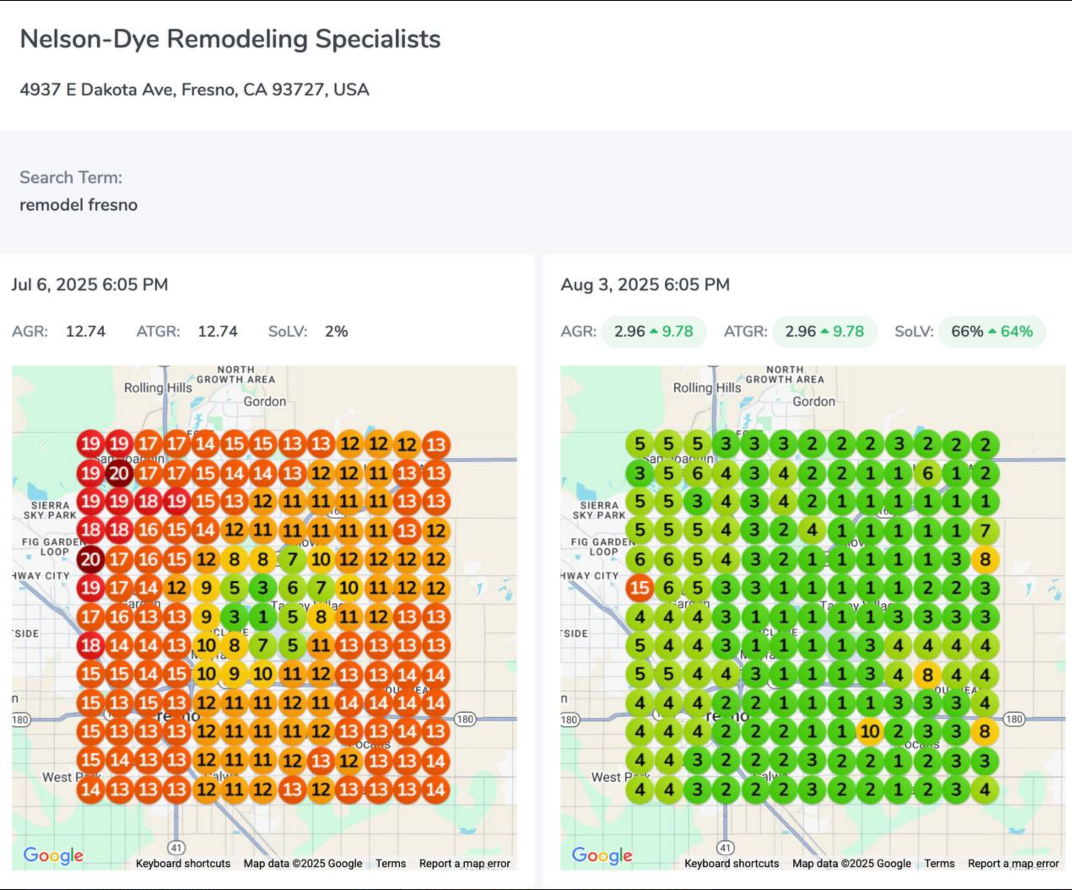
Source: three supplied Nelson-Dye local ranking reports. These are sampled rankings for the terms and locations shown, not the result seen by every searcher. The reports do not measure enquiries, signed projects or revenue, and do not isolate which individual changes caused the movement.
The practical lesson is to assess visibility across relevant locations and services. Our guide to reading a local ranking grid explains how to interpret that evidence. For service scope, see local and organic SEO and our Fresno SEO page.
How do you connect visibility with suitable projects?
Keep the search report and the enquiry record connected, while treating them as different measures. More visibility can create an opportunity to be considered; the enquiry and sales process show what happens next.
A practical review follows the stages from enquiry to consultation, proposal and won or lost project. Record why an enquiry did not progress: unsuitable scope, location, timing or another known reason. Avoid treating every contact or estimate as a sale.
That information can guide the next decision. If the wrong project types dominate, review the campaign targeting and page copy. If relevant enquiries stall before a consultation, review the information provided and follow-up. If very few suitable people reach the page, investigate visibility and demand.
When might advertising help?
A focused campaign can put a defined service in front of people considering that work. It still needs a relevant page and a clear way to assess the resulting enquiries. Our Google Ads service and SEO versus Google Ads guide explain how to evaluate the options.
Approved project stories can also support social media content. Keep the homeowner's permission and the context of the work intact wherever the story appears.
What should a remodeling marketing proposal explain?
Will this bring in higher-value projects?
A proposal should define the project types and qualification criteria you want to pursue, then explain how they will be measured. A ranking change or a larger lead count alone cannot establish project value, margins or a guaranteed pipeline.
Should we rebuild the website or improve the existing one?
Base that decision on what prevents a homeowner from finding, understanding or contacting the business. Existing useful pages and search visibility should be accounted for in a redesign. If the concern is visibility, start with diagnosing why the website is not showing in Google.
Does a top-three average mean we rank across the whole city?
No. An average summarizes the locations tested for one term. Ask to see the individual grid points, dates, search terms and measurement settings. The Nelson-Dye example above shows why a single headline rank needs that context.
What should we bring to an initial conversation?
Bring your priority project types, service area, available capacity, website and permitted examples of completed work. Recent enquiry outcomes help distinguish a visibility problem from a project-fit or follow-up problem. You can also explore our documented client work and meet the team.